Technical Specifications
Magnification: 2.5x
Barrel: 1.25″
Weight: 0.45 lbs
📦FREE SHIPPING FOR ORDERS OVER $500* Some exceptions may apply
💲Buy Now, Pay Later. Learn more
Tele Vue 2.5x 1.25" Powermate (PMT-2513) is backordered and will ship as soon as it is back in stock.
Pickup available at ASTRONOMY PLUS
Usually ready in 2 hours
*Some exceptions may apply. More info
*Ordered before 2PM ET & Business Hours only / This is an estimation and may vary
🛫 If the item is unavailable: It may be in transit to us or on order with the supplier. If not, we will promptly place the order. In case of delays, we will do our best to keep you informed. Don't hesitate to email us for delays.
Buy with confidence from a trusted Canadian astronomy retailer. We provide full pre-sale and after-sale support, expert advice, warranty assistance, and real technical help from passionate astronomers.
Pickup available, Usually ready in 2 hours
3008 Rue Brodeur O
Unité 307
Saint Alphonse De Granby QC J0E 2A0
Canada
The Tele Vue 2.5x 1.25″ Powermate stands less than 3″ out of your focuser.. It is parfocal in ALL 1¼” diagonals and prisms. For this reason, it is highly recommended over standard Barlows for 1¼” diagonals and refractors such as the Tele Vue-60.
"While Barlows are powerful tools, the negative element defining them also limits their ability. The simple negative element Barlow increases eyepiece eye-relief. With short focal length eyepieces the effect is negligible. However, on long focal length eyepieces the exit pupil position moves well beyond the designer’s intended position, resulting in vignetting with many eyepieces. This is why “Shorty” Barlows in particular, with their strong negative element often vignette and degrade long focus eyepieces. My 4-element form picks up where the Barlow concept can go no further. Powermate™ is a technically universal solution, using a positive field lens to redirect field rays. The result is an exit pupil that stays where the eyepiece designer intended. With freedom from aberrations, greater magnification potential, and compact size, I hope you’ll agree Powermate™ raises the standard for image amplification." — Al Nagler
Al Nagler’s 4-element concept, continues the tradition of full-field sharpness with optimum aberration control. Like long eye-relief? Retain the eye-relief of long focal length eyepieces, while at high power. Enjoy, for example, the sharpness and comfort of the 32mm Plössl at up to 5 times the power!
To understand the Powermate™, we must first understand the Barlow lens. Barlows amplify the power of a telescope. They can be considered “focal reducers” for eyepieces, or “focal extenders” for objectives. Terence Dickenson, in his Barlow test report in Sky and Telescope, July 1997, says: “Technology has erased the old objections. A modern Barlow will not degrade your telescope’s optics. Anyone telling you otherwise is using outdated information. Moreover, the highly regarded Nagler eyepieces and their clones have built-in Barlows, ample evidence that the lens is not some detrimental intruder.” Thanks, Terence, for laying the myth of the degrading Barlow to rest.
A high quality Barlow must be properly designed and manufactured in order to avoid compromising a telescope’s color and spherical aberration corrections. The “invisibility” of Tele Vue’s 2-element Barlows has been noted in test reports in the astronomy magazines. However, by the nature of its negative power lens, a Barlow will do more than just increase magnification, regardless of the number of elements.
The diverging rays leaving the Barlow result in moving the exit pupil further out, thereby extending the eye relief. In short to medium focal length eyepieces the change is not noticeable. However, in the case of long focal length eyepieces, the increase can be significant and not without performance consequences.
Vignetting can occur due to the altered ray path, when the eyepiece’s lenses are not large enough in diameter to allow all the rays to make it through. Shorter Barlows, or ones with too much magnification, only exacerbate the problem because the ray path entering the eyepiece is steeper.
We had to go beyond the Barlow concept to achieve the goal of a compact, high power, fully corrected image amplifier. The Powermate™ consists of a negative doublet plus a positive “pupil-correcting” doublet. This 4-element system provides the magnifying function of a Barlow without its limitations by restoring the field rays back to their original direction, as if the Powermate™ were not there. The result is a pure magnification increase.
In addition to full multi-coating, Powermates™ include other Tele Vue special touches such as safety undercuts where practical on the chrome barrel and captive lock screws that can’t fall out, and filter threads. Our 100% QC program at f/4 insures that Powermates™ will add dramatic power (and NOTHING ELSE) to your favorite eyepieces.
If, for example, you own a 24mm Panoptic, you’ll have the power of a 12mm focal length eyepiece with the 2.0x Powermate™, 9.6mm with the 2.5x Powermate™, a 6mm with the 4x Powermate™, or a 4.8mm with the 5x Powermate™!
Note for Dobsonian/Newtonian Owners : When using Tele Vue's Paracorr coma corrector, the 2.5x or 5x Powermate™ should be inserted into the Paracorr's 1¼" adapter (i.e., between the Paracorr and the eyepiece). For 2x and 4x 2" Powermates™, first insert the Powermate™ into the focuser, then the Paracorr into the Powermates™.
Magnification: 2.5x
Barrel: 1.25″
Weight: 0.45 lbs
I love the double stack, it was tough to find online, and this was the only store that had it, the shipping was very fast and very well packaged.
Excellent camera for "Lucky imaging" of planets.
Products as described, arrived 3 days before due date.
This is a great deep sky scope, and I am looking forward to getting some great pictures with it, all I need now are some clear skies (it's raining at the moment)
Very sturdy and better than expected!
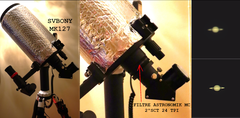
ASTRONOMIK MC CLEAR FILTER 2’’ SCT 24 TPI
Se visse directement sur l’adaptateur 2’’ SCT 24 TPI , votre dos visuel se visse sur le ASTRONOMIK MC CLEAR FILTER 2’’ SCT 24 TPI.
1) Permet de sceller le tube optique. Une touche de graisse de silicone pure, de qualité, celle pour les équipements de plongée assure l’étanchéité.
2) Empêche les contaminants de s’infiltrer
3) Empêche l’effet cheminée lorsqu’on change un oculaire ou un accessoire par temps froids.
4) Combiné à une isolation thermique de l'OTA un isolant thermique à double face genre REFLECTIX, permet de sortir l’instrument d’un local chauffé vers la température frigide extérieure pour observer immédiatement sans attendre l’équilibrage des températures.
J’ai testé de 25C à 5C, sur deux nuits à l’oculaire clavé 10mm dès l’installation 5 minutes après la sortie de l’instrument, l’image est absolument nette avec seulement la turbulence d’un seeing de 3-4, et ce durant toute la durée de la séance.
Images de Saturne au MK127 de SVBONY F:1500mm, Caméra ZWO ASI 678MC au foyer primaire, Filtre 1.25" Baader contrast boost, capture .SER, Sharpcap, PIPP, AS4!, registax 6.
Les photos sont un stack des images brutes stabilisé de PIPP, et l'autre un léger traitement dans Registax 6.
Le 27 octobre vers 21h30 5 à 10 minutes après avoir sorti l’instrument, viewing 3/5. Hier avec barlow QT 2,25x Baader, résultat similaire. C'est ce que j'espérait, les tests se poursuivre.
ZWO Seestar S50 Pro. Makes astrophotography easy. Great for beginners looking to get into the hobby. Lightweight and portable. Highly recommend this scope.
I love the double stack, it was tough to find online, and this was the only store that had it, the shipping was very fast and very well packaged.
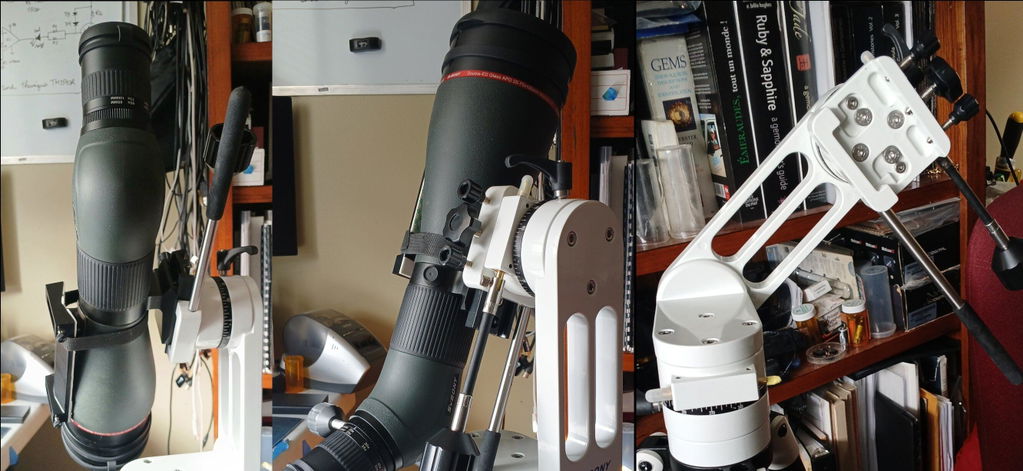
1. Construction robuste
2. Assemblage requis : habiletés mécaniques requises, particulièrement les précautions et les méthodes et ordres de serrage sécuritaire des vis Allen. Certaines vis sont difficiles à desserrer ou à serrer adéquatement.
3. Montage configurable selon les préférences de l’observateur :
a. Orientation à droite ou à gauche du module d’altitude à queue d’aronde
b. Orientation des câbles d’ajustement fins selon les préférences de l’observateur en démontant et réorientant soit le bloc de queue d’aronde pour l’altitude, soit en démontant et réorientant la base du module d’altitude, pour le câble d’azimuts.
c. Dans sa position verticale, la monture permet d’orienter l’instrument entre -60° à +60 d’altitude, les objets au zénith ne sont pas accessibles. Il est possible de monter en diagonale l’axe d’altitude, le zénith devient accessible, mais le centre de gravité de la monture se trouve déplacé, attention.
d. Les ajustements fins procurent un mouvement très doux et constant.
e. Les manettes de verrouillages des axes sont ajustables dans une position confortable par un mécanisme à ressort qui permet d’orienté les manettes.
f. Le verrouillage des axes ne verrouille que les déplacements rapides et n’affecte pas les réglages fins par flexibles qui sont des mécanismes indépendants.
4. S’adapte parfaitement au trépied Sky-Watcher Star adventurer
5. Comme toujours un manuel d’instruction mal rédigé avec traductions douteuse ou simplement laissée en anglais.
6. Un accessoire présent dans la boîte qui n’est pas dans le manuel, c’est une barre butoir qui protège contre les dommages possibles au tube optique si l’observateur ajuste l’altitude rapidement sans se méfier au-delà du +60°. Le butoir empêche le tube de frapper la base de la monture en bloquant le mouvement.
7. Monture idéale pour mon SA401 100mm APO ED dédié aux observations de la nature et occasionnellement des observations astronomiques.
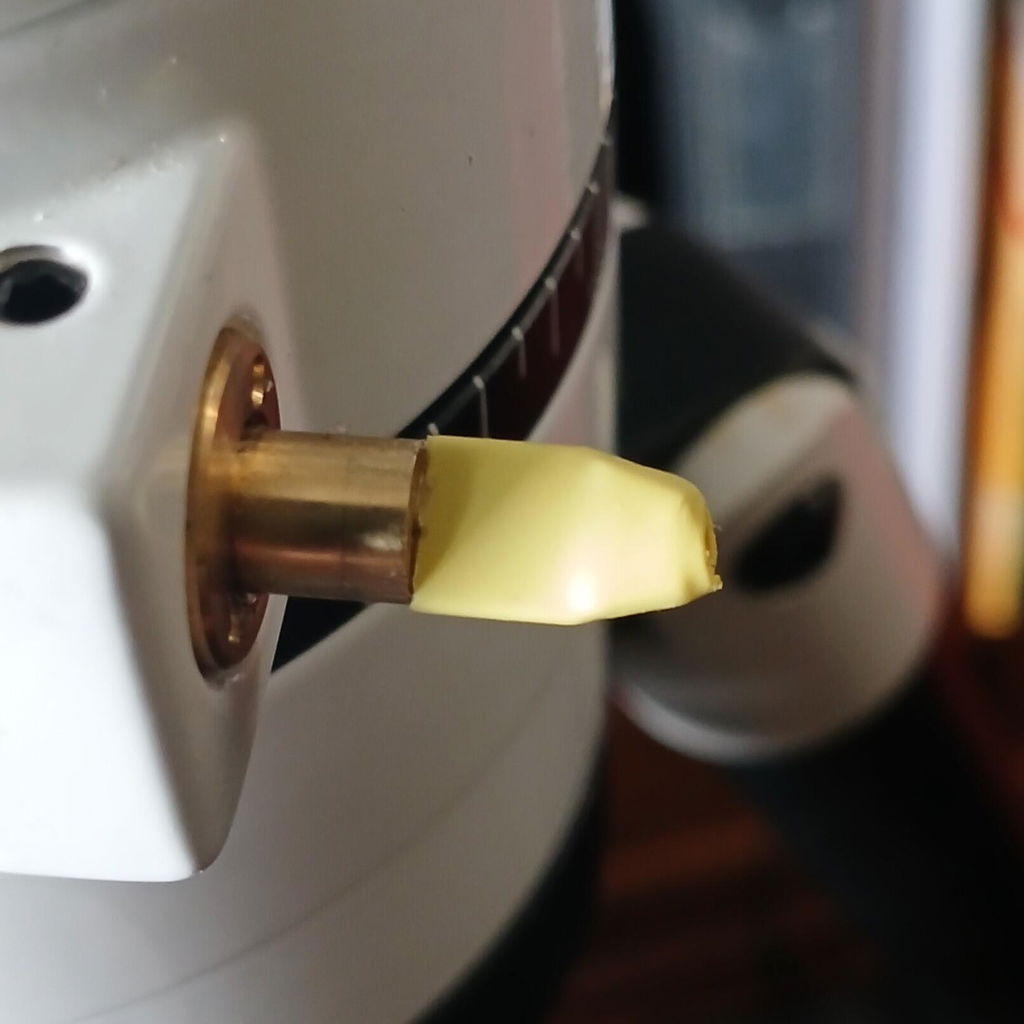
8. Pour éviter que les manettes de réglage fin ne se desserrent, j'ai ajouté une gaine thermorétractable sur l'embout en laiton où se connectent les flexibles. Une fois vissées, les manettes restent bien en place.
This 80 mm F5 telescope is very impressive
Pros. Excellent optics very light weight
Cons. Tripod and finder scope are almost unusable. Change to a 90 degree diagonal and purchase a better quality tripod
Still well worth the money. May be buying a second one
J’ai échangé mon S50 pour le nouveau S50 Pro et je suis très satisfait. De plus, l’application est régulièrement mise à jour pour offrir plus de possibilités et de facilité. J’adore l’utiliser pour empiler des photos d’astres lointaines pendant que je fais de l’observation visuelle avec mon SCT.