Player One Neptune-M USB3.0 Mono Camera (NEPTUNE-M)
Player One Neptune-M USB3.0 Mono Camera (NEPTUNE-M) is backordered and will ship as soon as it is back in stock.
Pickup available at ASTRONOMY PLUS
Usually ready in 2 hours
FREE SHIPPING FOR ORDERS OVER $500* 🆓🚚
FREE SHIPPING FOR ORDERS OVER $500* 🆓🚚
*Some exceptions may apply. More info
We Have it in Stock? We're on it, shipping your order on the same day.
We Have it in Stock? We're on it, shipping your order on the same day.
*Ordered before 2PM ET & Business Hours only / This is an estimation and may vary
What if the product is not in stock?
What if the product is not in stock?
🛫 If the item is unavailable: It may be in transit to us or on order with the supplier. If not, we will promptly place the order. In case of delays, we will do our best to keep you informed. Don't hesitate to email us for delays.
🇨🇦 Canadian Authorized Dealer
🇨🇦 Canadian Authorized Dealer
Buy with confidence from a trusted Canadian astronomy retailer. We provide full pre-sale and after-sale support, expert advice, warranty assistance, and real technical help from passionate astronomers.

Player One Neptune-M USB3.0 Mono Camera (NEPTUNE-M)

Player One Neptune-M USB3.0 Mono Camera (NEPTUNE-M) is backordered and will ship as soon as it is back in stock.
Player One Neptune-M USB3.0 Mono Camera
The Neptune series is a 1/2-inch format planetary camera series for the top player. It is larger than 1/3-inch and has a higher resolution, and is more suitable for astronomy enthusiasts.
The main hit of the Neptune series is Neptune-C II, yes, you read it right. We directly released the second-generation Neptune model on the grounds that the plan could not keep up with the changes.
Beside the brightest star Neptune-C II, we also grandly launch other two highly praised models Neptune-C and Neptune-M.

Neptune-M is a planetary camera developed by Player One Astronomy, which adopts the Sony IMX178 1/1.8” format sensor. The 2.4um pixel size accommodates a well depth of 15ke with a total of 6.4MP (the resolution is 3096*2078), and the diagonal is 9mm.
We need Neptune-M (IMX178 mono sensor), because IMX464 only has color type. For many enthusiasts, without monochrome camera, a lot of shooting flexibility will be vanished, so Neptune-M is to make up for this.
With a 1/1.8 inch sensor, the Neptune series are very suitable for sun and moon mosaic photography.
Connecting the Neptune-C camera to a telescope with an 1.25″ T-Mount, or adding a Barlow lens between the camera and a telescope to extend the focal length for more details.
With a CS lens attached on the Neptune-C camera,it can be used as an all-day camera or meteor monitoring camera.
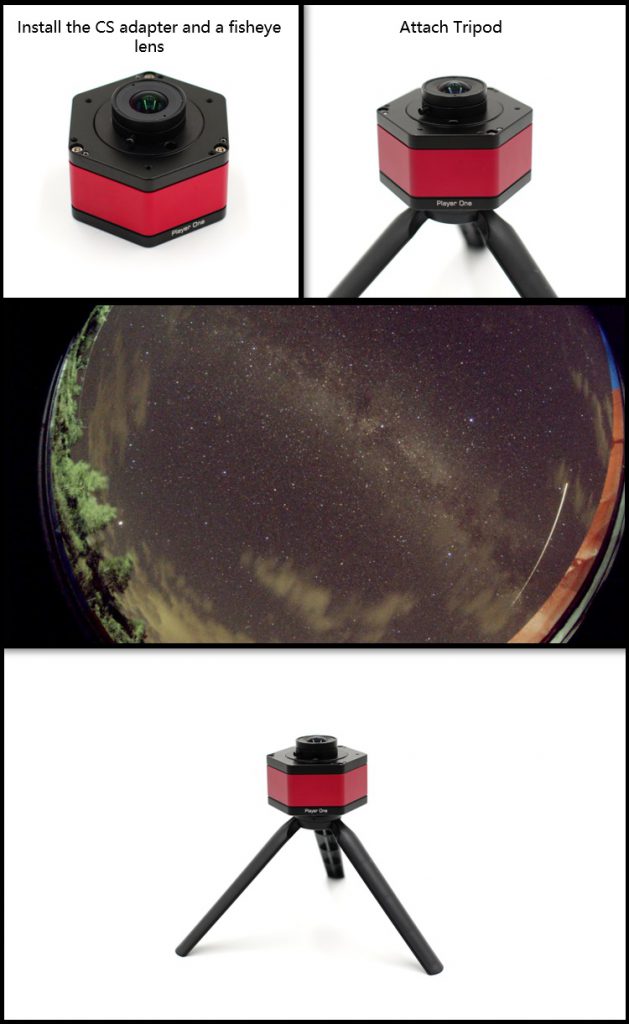
The naming of Player One Astronomy cameras is unique. For example, we name the planetary cameras after planets (They are Mercury, Venus, Mars, Jupiter, Saturn, Uranus and Neptune, Earth is not included). The size of each planet to a certain extent, represents the size of camera sensors. We will name Saturn with a 1-inch sensor camera, and for Neptune, we will named it with a 1/1.8 inch senor camera. All names will be engraved on the housing of the cameras.

The planetary cameras developed by Player One Astronomy uses a scientific and technological regular hexagon to construct the main body line, supplemented by round chamfers to achieve both rigidity and flexibility. The positive red, which is like a summer fire, is matched with the low-key and steady black, and the super-fine frosting process on the entire surface makes the camera look luxurious and cool, highlighting the style of high-end players.
2nd Gen – Sensor Tilt Plate
The built-in high-density sponge shading pad can block the light from the side slits without any side leakage.

When taking solar photograph with prominence telescope, the Newton ring is annoying. Smoother solar image without Newton ring could be taken by adjusting the focal plate. Get a much smaller field curvature of the telescope.
256M DDR3 Cache
Player One Astronomy cameras are the first one who adpots the DDR3 cache in all planetary cameras in the world! It helps stabilize and secure data transmission, it effectively avoids frame dropping and greatly reduces readnoise.
With the DDR3 cache, the camera does not have high demands on computing needs any longer, it will still has excellent performance even if it is connected to a USB 2.0 port.
Technical Specifications
| Sensor |
SONY IMX178 1/1.8" CMOS (mono) |
|---|---|
| Diagonal |
9mm |
| Total Pixels |
6.4 Mega Pixels |
| Max Resolution |
3096×2078 |
| Pixel Size |
2.4μm |
| Chip Size |
7.4mm×5.0mm |
| Frame Rate |
60FPS(10bit) |
| Shutter |
Rolling shutter |
| Exposure Range |
32μs-2000s |
| Readout Noise |
2.2e~1.3e |
| QE Peak |
≈80% |
| Full Well |
15k e |
| ADC |
14 bit |
| Data Port |
USB3.0/USB2.0 |
| Adapter |
1.25″ / M42X0.75 |
| Back Focal Length |
12.5mm |
| Protective Window |
D21*1.1MM High Quality AR Plus (Anti Reflection) Multi-Layer Coating |
| Diameter |
66mm |
| Weight |
180g |
| Resolution and FPS |
Under USB3.0 mode |
In the Box
- Camera and T-mount
- USB3.0 Cable
- ST4 Cable
- M2 Hexagonal wrench
- 1.25" Cover
- Air blower
Manuals & Warranty
The PlayerOne Neptune M Mono camera is well suited to my introduction to narrowband imaging and performed well on three sessions since my purchase.I found the camera to be extremely sensitive and due to its small 2.4um pixels, perfectly suitable to my 102mm refracting telescope's ability to pick up lots of fine detail in the short sessions employed. My tests included using an OIII and Hbeta 2" filters, but no Ha filter was employed. The photo included is of the filament Veil Nebula near Pickering's Triangle using an 18nm OIII filter(1hr@f3.9 - gain 225 offset 50) + Flats, darks & biases. Stacked in DSS and Level stretched with no other editing.
The camera itself is well built, comes with nice accessories and the flat cable is a bonus. My calibration images did not show any great defects, banding nor hot or cold pixels.
The potential for use as a guide camera can not be underestimated, nor can it's planetary and lunar capabilities. I am definitely not employing this camera as directed, more exploring it's fast, lucky imaging narrowband compatibility using fast focal ratio telescopes (F3.9 102mm Refracting & F4.4 154mm imaging Newtonian).
I was extremely happy to find it available and purchase it trouble free at AstronomyPlus.