We Have it in Stock? We're on it, shipping your order on the same day.
*Ordered before 2PM ET & Business Hours only / This is an estimation and may vary
What if the product is not in stock?
🛫 If the item is unavailable: It may be in transit to us or on order with the supplier. If not, we will promptly place the order. In case of delays, we will do our best to keep you informed. Don't hesitate to email us for delays.
🇨🇦 Canadian Authorized Dealer
Buy with confidence from a trusted Canadian astronomy retailer. We provide full pre-sale and after-sale support, expert advice, warranty assistance, and real technical help from passionate astronomers.
Share:
If you cancel your pre-order, any deposit paid is non-refundable. If the order was paid in full, a cancellation fee of 5% of the total amount paid will be deducted to cover credit card processing fees. The remaining balance will be refunded.
DwarfLab DWARF Draco Smart Telescope SHO Version
ASTRONOMY PLUS
Pickup available,
Usually ready in 2 hours
3008 Rue Brodeur O Unité 307 Saint Alphonse De Granby QC J0E 2A0 Canada
DwarfLab DWARF Draco Smart Telescope SHO Version
is backordered and will ship as soon as it is back in stock.
DwarfLab DWARF Draco Smart Telescope SHO Version
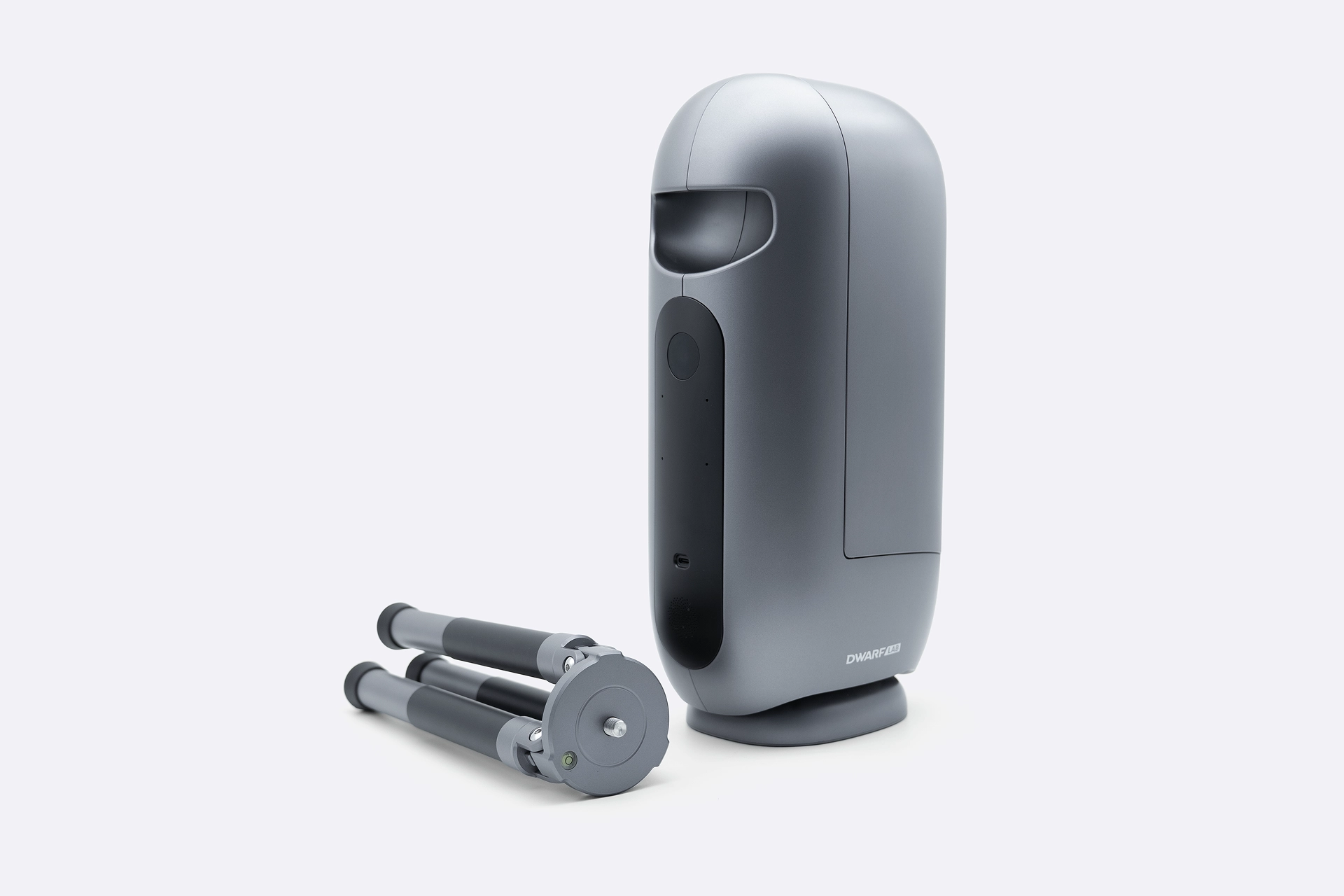
Draco is DWARFLAB's latest high-end smart telescope — a fully integrated imaging system that brings observatory-grade deep-sky capability to a portable, travel-ready body.
Built-in S II + O III filter for automated nebula imaging.
External ND filter included for solar imaging.
90mm Large Aperture
Collect more light to reveal faint structures and fine detail in nebulae and galaxies.
1/1.3-Inch Telephoto Camera
The flagship telephoto camera captures more image information, making lunar, planetary, and deep-sky subjects look sharper and more detailed.
Equipped with a TEC thermoelectric cooler and fan, the system features automatic TEC thermal control. It can lower the sensor temperature by approximately 5 °C below ambient temperature, fundamentally reducing thermal noise in long-exposure astrophotography and delivering clean imaging data.
Cooling reduces thermal noise at the source, and reused sensor heat helps keep the lens clear in cold or humid nights.
Portable 5.5kg Body
The integrated 5.5 kg body makes a professional astronomy system much easier to carry and take into the field.
5-Hour Battery Life
Long battery life supports a full night of imaging without constant worry about power.
IP55-Rated Protection
IP55 protection helps Draco stay reliable outdoors, even in dusty conditions or brief rain exposure.
1/1.8-Inch Wide-Angle Camera
The wide-angle camera helps with target finding, sky framing, and large-scale scenes like the Milky Way.
1/1.3-Inch Telephoto Camera
The telephoto camera is designed to bring distant celestial subjects closer and capture finer detail.
1/1.3-Inch Sensor
1200mm Equivalent Focal Length
50MP Resolution
2x2 Pixel Binning
Simultaneous Dual-Lens Capture
Wide-angle and telephoto can work together, so you can capture the broader sky and the main subject at the same time.
-20°C to 45°C Operating Range
Draco is built to perform across a wide range of real outdoor conditions, from cold winter nights to summer heat.
Rotating CMOS
Physical CMOS rotation gives you more freedom in framing and makes vertical or diagonal compositions much easier.
Free-Angle Composition
You can compose the shot the way you want, instead of being limited by the device’s position.
Rayleigh Criterion Formula
θ = 1.22 λ / D
As aperture D increases, the diffraction limited angular resolution θ becomes smaller, revealing finer deep sky detail.
Faint structures. Fine textures. Subtle layers hidden in the dark. Draco’s 90mm telephoto optics gather the light needed to reveal what smaller systems can miss.
SHO Edition
Built-in Filters: Astro/Dark-frame/Dual-narrowband(Hα+O III)/Dual-narrowband(S II+O III) Adds a built-in S II + O III dual-narrowband filter, targeting S II at 674 nm and O III at 503 nm with the same 13 ± 3 nm bandpass. The S II + O III and Hα + O III filters work automatically in sequence to capture real S II, Hα, and O III data. Draco then handles separation, color mapping, and composition automatically, producing classic blue-and-gold Hubble Palette images with one tap.
The SHO Edition includes an external ND filter for solar imaging.
1.2μm Native Pixels for Finer Detail
When imaging the Sun, Moon, and planets, Draco uses native 1×1 pixel readout and intelligently crops around the target to reduce unnecessary black space. This finer sampling helps capture details such as lunar craters, sunspots, Saturn’s rings, and Jupiter’s Great Red Spot.
Field Rotation Correction
The CMOS rotates with the sky to physically counter field rotation, delivering clean images without complex polar alignment.
Stars, stay true to the edge
A 90mm aperture defines the physical ceiling of image quality. To truly reach it, every beam of light must be precisely controlled. Draco uses an aberration corrected optical system to precisely correct light deviation deep within the lens set. From the center to the edge of the frame, stars stay pin sharp. A leap in image quality, and an elegant answer to physics.
Temperature, mastered all night.
Draco manages heat across the system. Draco rethinks the flow of energy, turning old imaging challenges into part of the solution CMOS cooling for lower noise: Built-in cooling and heat dissipation reduce thermal noise at the source, creating an exceptionally clean data foundation. Automatic lens dew prevention: Reused sensor heat is directed to warm the lens precisely, keeping the view clear and transparent through the night. From -20°C winter nights to 45°C summer heat, Draco runs steadily, protecting every frame from capture to final image.
Folded Optical Design
Big aperture. Compact by design. 386mm Body | 90mm Aperture | 340mm Focal Length Inside this body, Draco folds a 90mm aperture and 340mm focal length into a compact optical path. Then it goes further.
Super Fast F3.8 Focal Ratio
Exceptionally fast at F3.8, Draco delivers around 2.2× the light throughput of typical F5.6 systems, capturing more light in less time. A faint nebula signal that once took 6 hours to gather can now be captured sharply in under 3 hours. With 300 second ultra-long exposures, Draco gathers light faster while keeping the image remarkably clean.
Physical CMOS Rotation
Your setup should follow your vision. Not the other way around. With Draco, you can rotate the frame directly in the app, while the CMOS sensor physically turns to match. Go wide. Go vertical. Go off-axis. Just the frame you had in mind. Compose Freely. Define Your Own Angle.
Q&A
Choosing Draco
What is Draco, and who is it for?
Draco is a portable, all-in-one smart observatory designed for deep-sky imaging and multi-scenario astronomy. It combines a 90 mm aperture, 340 mm focal length, fast f/3.8 optics, 300-second exposures, a built-in guide scope, physical CMOS field rotation correction, dual cameras, and an automated app workflow in a 5.5 kg body. It also supports EQ Mode for more stable tracking and deeper imaging. Draco is suitable for beginners who want a simpler workflow and for advanced users who want Pro Mode and FITS/TIFF export.
How is Draco different from DWARF 3 and DWARF mini?
DWARF mini is the most compact option and is aimed at simple entry-level use. DWARF 3 is a portable multi-scenario telescope for deep-sky and wide-angle imaging. Draco is the performance-focused step up, with a larger aperture, faster optics, longer single-frame exposures, built-in guiding, field rotation correction, EQ Mode, and a more observatory-like imaging workflow.
Can Draco replace a traditional telescope? Draco brings together target finding, tracking, guiding, field rotation correction, capture, stacking, and mobile processing in one integrated system. It simplifies workflows that would normally require multiple pieces of a conventional astrophotography rig. Because it does not include an eyepiece for live visual observation, it is best viewed as a powerful imaging-focused complement to a traditional telescope.
Imaging Capability and Use Cases
What can Draco capture? Draco supports deep-sky, Solar System, Milky Way, star-trail, time-lapse, panorama, and automatic-tracking scenarios. It is designed for galaxies, nebulae, clusters, the Sun, the Moon, and planets, as well as wider sky compositions and landscape-style imaging.
Can both cameras shoot at the same time? Yes. Draco can record telephoto and wide-angle views in the same session, giving users both the target detail and the wider scene.
Can Draco capture deep-sky objects from a city? Yes. Bright clusters, brighter nebulae, the Moon, and the Sun are suitable city targets. Fainter objects such as galaxies and dust structures will benefit from darker skies.
Can Draco photograph the Milky Way? Yes. The wide-angle camera and Milky Way mode support Milky Way imaging, while final results will depend on sky conditions, moon phase, cloud cover, and total capture time.
Can Draco image the Sun safely? Yes, using the approved solar workflow. The Standard Edition uses the built-in solar filter, while the SHO Edition uses the external magnetic filter system as configured. Users should always follow the in-app safety flow and never point Draco at the Sun outside the approved workflow.
Can Draco capture the Moon and planets? Yes. Draco supports lunar and planetary imaging with high-resolution output from the main camera.
Can Draco create star trails, time-lapse videos, panoramas, or tracking shots? Yes. Draco supports star trails, time-lapse video, panorama, and automatic tracking.
Will my images look the same as sample images? Image quality varies with sky brightness, cloud cover, moon phase, target altitude, seeing, total capture time, stability, focus, and processing choices. Sample images show what Draco can achieve under specific conditions, but results will vary.
Technical Specifications
STANDARD EDITION
SHO EDITION
OPTICAL SYSTEM
Aperture diameter
90 mm (telephoto) 2.96 mm (wide-angle)
90 mm (telephoto) 2.96 mm (wide-angle)
Focal Length
340 mm (telephoto) 5.56 mm (wide-angle)
340 mm (telephoto) 5.56 mm (wide-angle)
35 mm-Equivalent Focal Length
1200 mm (telephoto, astronomy mode) 1280 mm (telephoto, non-astronomy mode) 23.3 mm (wide-angle)
1200 mm (telephoto, astronomy mode) 1280 mm (telephoto, non-astronomy mode) 23.3 mm (wide-angle)
Field of View
Astronomy Mode (Deep Sky / Solar System) D 2.059°(telephoto); D 85.74°(wide-angle); H 0.905°, V 0.512° (guiding) Other Modes D 1.936°(telephoto); D 85.74° (wide-angle); H 0.905°, V 0.512° (guiding)
Astronomy Mode (Deep Sky / Solar System) D 2.059°(telephoto); D 85.74°(wide-angle); H 0.905°, V 0.512° (guiding) Other Modes D 1.936°(telephoto); D 85.74° (wide-angle); H 0.905°, V 0.512° (guiding)
Built-in, 7.7 V, 10000 mAh supports external USB charging
Built-in, 7.7 V, 10000 mAh supports external USB charging
Power Input
Type-C
Type-C
Connectivity (Operating Range)
Wi-Fi, Bluetooth, NFC (Wi-Fi up to 10 m)
Wi-Fi, Bluetooth, NFC (Wi-Fi up to 10 m)
Storage
Built-in 128 GB
Built-in 128 GB
SOFTWARE & MEDIA
Shooting Modes
Photo (telephoto and wide-angle) Video (telephoto and wide-angle) Astronomy (telephoto and wide-angle) Panorama (telephoto and wide-angle) Burst (telephoto and wide-angle) Time-lapse (telephoto and wide-angle)
Photo (telephoto and wide-angle) Video (telephoto and wide-angle) Astronomy (telephoto and wide-angle) Panorama (telephoto and wide-angle) Burst (telephoto and wide-angle) Time-lapse (telephoto and wide-angle)
Draco is equipped with a standard aluminum‑alloy tripod. Platform, connectors and legs are aluminum alloy for high support strength and light weight. TPR foot pads enhance ground friction and placement stability.
You will receive an email when your post is approved
Please leave this popup open whilst your media is uploading
From our customers
Comments
Be the first to comment!
Shop This Post
Price:
Original price:
Your cart
DwarfLab
DwarfLab DWARF Draco Smart Telescope SHO Version
Regular price$2,29900
Unit price
DwarfLab DWARF Draco Smart Telescope SHO Version
Draco is DWARFLAB's latest high-end smart telescope — a fully integrated imaging system that brings observatory-grade deep-sky capability to a portable, travel-ready body.
Built-in S II + O III filter for automated nebula imaging.
External ND filter included for solar imaging.
90mm Large Aperture
Collect more light to reveal faint structures and fine detail in nebulae and galaxies.
1/1.3-Inch Telephoto Camera
The flagship telephoto camera captures more image information, making lunar, planetary, and deep-sky subjects look sharper and more detailed.
Equipped with a TEC thermoelectric cooler and fan, the system features automatic TEC thermal control. It can lower the sensor temperature by approximately 5 °C below ambient temperature, fundamentally reducing thermal noise in long-exposure astrophotography and delivering clean imaging data.
Cooling reduces thermal noise at the source, and reused sensor heat helps keep the lens clear in cold or humid nights.
Portable 5.5kg Body
The integrated 5.5 kg body makes a professional astronomy system much easier to carry and take into the field.
5-Hour Battery Life
Long battery life supports a full night of imaging without constant worry about power.
IP55-Rated Protection
IP55 protection helps Draco stay reliable outdoors, even in dusty conditions or brief rain exposure.
1/1.8-Inch Wide-Angle Camera
The wide-angle camera helps with target finding, sky framing, and large-scale scenes like the Milky Way.
1/1.3-Inch Telephoto Camera
The telephoto camera is designed to bring distant celestial subjects closer and capture finer detail.
1/1.3-Inch Sensor
1200mm Equivalent Focal Length
50MP Resolution
2x2 Pixel Binning
Simultaneous Dual-Lens Capture
Wide-angle and telephoto can work together, so you can capture the broader sky and the main subject at the same time.
-20°C to 45°C Operating Range
Draco is built to perform across a wide range of real outdoor conditions, from cold winter nights to summer heat.
Rotating CMOS
Physical CMOS rotation gives you more freedom in framing and makes vertical or diagonal compositions much easier.
Free-Angle Composition
You can compose the shot the way you want, instead of being limited by the device’s position.
Rayleigh Criterion Formula
θ = 1.22 λ / D
As aperture D increases, the diffraction limited angular resolution θ becomes smaller, revealing finer deep sky detail.
Faint structures. Fine textures. Subtle layers hidden in the dark. Draco’s 90mm telephoto optics gather the light needed to reveal what smaller systems can miss.
SHO Edition
Built-in Filters: Astro/Dark-frame/Dual-narrowband(Hα+O III)/Dual-narrowband(S II+O III) Adds a built-in S II + O III dual-narrowband filter, targeting S II at 674 nm and O III at 503 nm with the same 13 ± 3 nm bandpass. The S II + O III and Hα + O III filters work automatically in sequence to capture real S II, Hα, and O III data. Draco then handles separation, color mapping, and composition automatically, producing classic blue-and-gold Hubble Palette images with one tap.
The SHO Edition includes an external ND filter for solar imaging.
1.2μm Native Pixels for Finer Detail
When imaging the Sun, Moon, and planets, Draco uses native 1×1 pixel readout and intelligently crops around the target to reduce unnecessary black space. This finer sampling helps capture details such as lunar craters, sunspots, Saturn’s rings, and Jupiter’s Great Red Spot.
Field Rotation Correction
The CMOS rotates with the sky to physically counter field rotation, delivering clean images without complex polar alignment.
Stars, stay true to the edge
A 90mm aperture defines the physical ceiling of image quality. To truly reach it, every beam of light must be precisely controlled. Draco uses an aberration corrected optical system to precisely correct light deviation deep within the lens set. From the center to the edge of the frame, stars stay pin sharp. A leap in image quality, and an elegant answer to physics.
Temperature, mastered all night.
Draco manages heat across the system. Draco rethinks the flow of energy, turning old imaging challenges into part of the solution CMOS cooling for lower noise: Built-in cooling and heat dissipation reduce thermal noise at the source, creating an exceptionally clean data foundation. Automatic lens dew prevention: Reused sensor heat is directed to warm the lens precisely, keeping the view clear and transparent through the night. From -20°C winter nights to 45°C summer heat, Draco runs steadily, protecting every frame from capture to final image.
Folded Optical Design
Big aperture. Compact by design. 386mm Body | 90mm Aperture | 340mm Focal Length Inside this body, Draco folds a 90mm aperture and 340mm focal length into a compact optical path. Then it goes further.
Super Fast F3.8 Focal Ratio
Exceptionally fast at F3.8, Draco delivers around 2.2× the light throughput of typical F5.6 systems, capturing more light in less time. A faint nebula signal that once took 6 hours to gather can now be captured sharply in under 3 hours. With 300 second ultra-long exposures, Draco gathers light faster while keeping the image remarkably clean.
Physical CMOS Rotation
Your setup should follow your vision. Not the other way around. With Draco, you can rotate the frame directly in the app, while the CMOS sensor physically turns to match. Go wide. Go vertical. Go off-axis. Just the frame you had in mind. Compose Freely. Define Your Own Angle.
Q&A
Choosing Draco
What is Draco, and who is it for?
Draco is a portable, all-in-one smart observatory designed for deep-sky imaging and multi-scenario astronomy. It combines a 90 mm aperture, 340 mm focal length, fast f/3.8 optics, 300-second exposures, a built-in guide scope, physical CMOS field rotation correction, dual cameras, and an automated app workflow in a 5.5 kg body. It also supports EQ Mode for more stable tracking and deeper imaging. Draco is suitable for beginners who want a simpler workflow and for advanced users who want Pro Mode and FITS/TIFF export.
How is Draco different from DWARF 3 and DWARF mini?
DWARF mini is the most compact option and is aimed at simple entry-level use. DWARF 3 is a portable multi-scenario telescope for deep-sky and wide-angle imaging. Draco is the performance-focused step up, with a larger aperture, faster optics, longer single-frame exposures, built-in guiding, field rotation correction, EQ Mode, and a more observatory-like imaging workflow.
Can Draco replace a traditional telescope? Draco brings together target finding, tracking, guiding, field rotation correction, capture, stacking, and mobile processing in one integrated system. It simplifies workflows that would normally require multiple pieces of a conventional astrophotography rig. Because it does not include an eyepiece for live visual observation, it is best viewed as a powerful imaging-focused complement to a traditional telescope.
Imaging Capability and Use Cases
What can Draco capture? Draco supports deep-sky, Solar System, Milky Way, star-trail, time-lapse, panorama, and automatic-tracking scenarios. It is designed for galaxies, nebulae, clusters, the Sun, the Moon, and planets, as well as wider sky compositions and landscape-style imaging.
Can both cameras shoot at the same time? Yes. Draco can record telephoto and wide-angle views in the same session, giving users both the target detail and the wider scene.
Can Draco capture deep-sky objects from a city? Yes. Bright clusters, brighter nebulae, the Moon, and the Sun are suitable city targets. Fainter objects such as galaxies and dust structures will benefit from darker skies.
Can Draco photograph the Milky Way? Yes. The wide-angle camera and Milky Way mode support Milky Way imaging, while final results will depend on sky conditions, moon phase, cloud cover, and total capture time.
Can Draco image the Sun safely? Yes, using the approved solar workflow. The Standard Edition uses the built-in solar filter, while the SHO Edition uses the external magnetic filter system as configured. Users should always follow the in-app safety flow and never point Draco at the Sun outside the approved workflow.
Can Draco capture the Moon and planets? Yes. Draco supports lunar and planetary imaging with high-resolution output from the main camera.
Can Draco create star trails, time-lapse videos, panoramas, or tracking shots? Yes. Draco supports star trails, time-lapse video, panorama, and automatic tracking.
Will my images look the same as sample images? Image quality varies with sky brightness, cloud cover, moon phase, target altitude, seeing, total capture time, stability, focus, and processing choices. Sample images show what Draco can achieve under specific conditions, but results will vary.
Technical Specifications
STANDARD EDITION
SHO EDITION
OPTICAL SYSTEM
Aperture diameter
90 mm (telephoto) 2.96 mm (wide-angle)
90 mm (telephoto) 2.96 mm (wide-angle)
Focal Length
340 mm (telephoto) 5.56 mm (wide-angle)
340 mm (telephoto) 5.56 mm (wide-angle)
35 mm-Equivalent Focal Length
1200 mm (telephoto, astronomy mode) 1280 mm (telephoto, non-astronomy mode) 23.3 mm (wide-angle)
1200 mm (telephoto, astronomy mode) 1280 mm (telephoto, non-astronomy mode) 23.3 mm (wide-angle)
Field of View
Astronomy Mode (Deep Sky / Solar System) D 2.059°(telephoto); D 85.74°(wide-angle); H 0.905°, V 0.512° (guiding) Other Modes D 1.936°(telephoto); D 85.74° (wide-angle); H 0.905°, V 0.512° (guiding)
Astronomy Mode (Deep Sky / Solar System) D 2.059°(telephoto); D 85.74°(wide-angle); H 0.905°, V 0.512° (guiding) Other Modes D 1.936°(telephoto); D 85.74° (wide-angle); H 0.905°, V 0.512° (guiding)
Built-in, 7.7 V, 10000 mAh supports external USB charging
Built-in, 7.7 V, 10000 mAh supports external USB charging
Power Input
Type-C
Type-C
Connectivity (Operating Range)
Wi-Fi, Bluetooth, NFC (Wi-Fi up to 10 m)
Wi-Fi, Bluetooth, NFC (Wi-Fi up to 10 m)
Storage
Built-in 128 GB
Built-in 128 GB
SOFTWARE & MEDIA
Shooting Modes
Photo (telephoto and wide-angle) Video (telephoto and wide-angle) Astronomy (telephoto and wide-angle) Panorama (telephoto and wide-angle) Burst (telephoto and wide-angle) Time-lapse (telephoto and wide-angle)
Photo (telephoto and wide-angle) Video (telephoto and wide-angle) Astronomy (telephoto and wide-angle) Panorama (telephoto and wide-angle) Burst (telephoto and wide-angle) Time-lapse (telephoto and wide-angle)
Draco is equipped with a standard aluminum‑alloy tripod. Platform, connectors and legs are aluminum alloy for high support strength and light weight. TPR foot pads enhance ground friction and placement stability.
Products as described, arrived 3 days before due date.
This is a great deep sky scope, and I am looking forward to getting some great pictures with it, all I need now are some clear skies (it's raining at the moment)
Astronomy Plus Pier Extension for ZWO, iOptron and Sky-Watcher Mounts
Claude Lamarre
ASTRONOMIK MC CLEAR FILTER 2’’ SCT 24 TPI
Se visse directement sur l’adaptateur 2’’ SCT 24 TPI
ASTRONOMIK MC CLEAR FILTER 2’’ SCT 24 TPI
Se visse directement sur l’adaptateur 2’’ SCT 24 TPI , votre dos visuel se visse sur le ASTRONOMIK MC CLEAR FILTER 2’’ SCT 24 TPI.
1) Permet de sceller le tube optique. Une touche de graisse de silicone pure, de qualité, celle pour les équipements de plongée assure l’étanchéité.
2) Empêche les contaminants de s’infiltrer
3) Empêche l’effet cheminée lorsqu’on change un oculaire ou un accessoire par temps froids.
4) Combiné à une isolation thermique de l'OTA un isolant thermique à double face genre REFLECTIX, permet de sortir l’instrument d’un local chauffé vers la température frigide extérieure pour observer immédiatement sans attendre l’équilibrage des températures.
J’ai testé de 25C à 5C, sur deux nuits à l’oculaire clavé 10mm dès l’installation 5 minutes après la sortie de l’instrument, l’image est absolument nette avec seulement la turbulence d’un seeing de 3-4, et ce durant toute la durée de la séance.
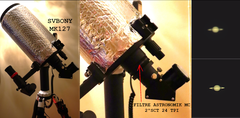
Images de Saturne au MK127 de SVBONY F:1500mm, Caméra ZWO ASI 678MC au foyer primaire, Filtre 1.25" Baader contrast boost, capture .SER, Sharpcap, PIPP, AS4!, registax 6.
Les photos sont un stack des images brutes stabilisé de PIPP, et l'autre un léger traitement dans Registax 6.
Le 27 octobre vers 21h30 5 à 10 minutes après avoir sorti l’instrument, viewing 3/5. Hier avec barlow QT 2,25x Baader, résultat similaire. C'est ce que j'espérait, les tests se poursuivre.
Astronomik MC-clear Filter
Darus
Helpful staff and competitive pricing make them a solid choice
Astronomy Plus is a reliable Canadian retailer specializing in telescopes and astrophotography gear.
Their product selection is excellent — everything from smart telescopes like the Seestar series to mounts, cameras, filters, and accessories from top brands. Items arrive in perfect condition and are well-stocked.
Shipping is impressively fast!
Astronomy Plus – Telescopes & Astrophotography Canada
Darus
Beautiful results without the complexity of traditional gear.
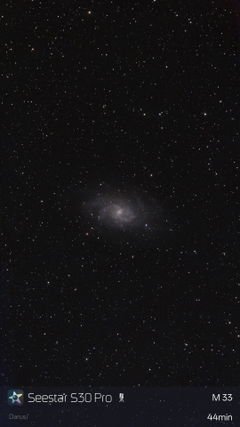
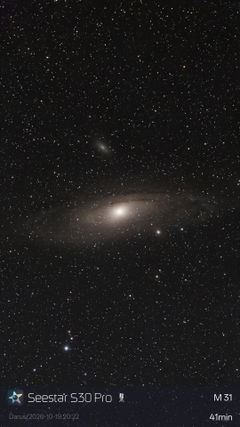
The ZWO Seestar S30 Pro is a compact, user-friendly smart telescope that makes deep-sky astrophotography surprisingly accessible. Its 30mm quadruplet APO optics and dual Sony sensors (IMX585 + IMX586) deliver sharp 4K images of nebulae, galaxies, and the Milky Way with minimal effort. Setup takes minutes: point it, select a target in the app, and it handles focusing, tracking, and stacking automatically. Ideal for beginners and casual imagers who want beautiful results without the complexity of traditional gear. Highly recommended.
ZWO Seestar S30 PRO All-in-One APO Smart Telescope (S30PRO)
Comparing head to head with Vortex DiamondBack, Pentax and Zeiss Terras, these 8x42s do very well at a significant savings. Well, the Zeiss pair is better, but only expected! For the money, these would serve anyone very well.
Products as described, arrived 3 days before due date.
This is a great deep sky scope, and I am looking forward to getting some great pictures with it, all I need now are some clear skies (it's raining at the moment)