

Gift-Cards

Finding the best telescope is no longer just a matter of comparing diameter or focal length. By 2026, the market has evolved. Automation, compact optics, hybrid instruments, and connected solutions are redefining the practice of amateur astronomy. At Astronomy Plus, we test instruments all year round, under dark skies as well as in urban environments. This article is for those who are wondering which telescope to buy, whether it's their first instrument or a carefully considered upgrade.
Here are our top 10 best telescopes used by astronomers and astrophotographers in 2026.
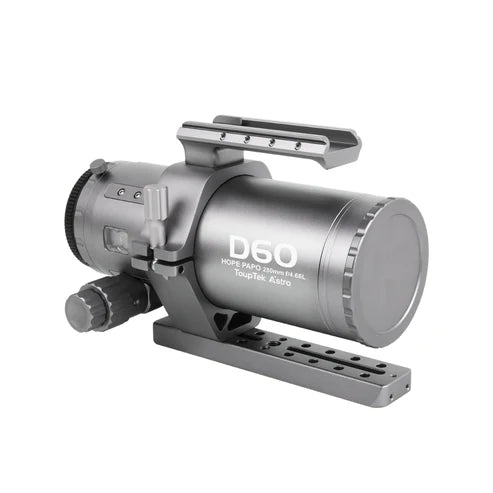
ToupTek HOPE D60 (Currently in beta, official release around February 2026))
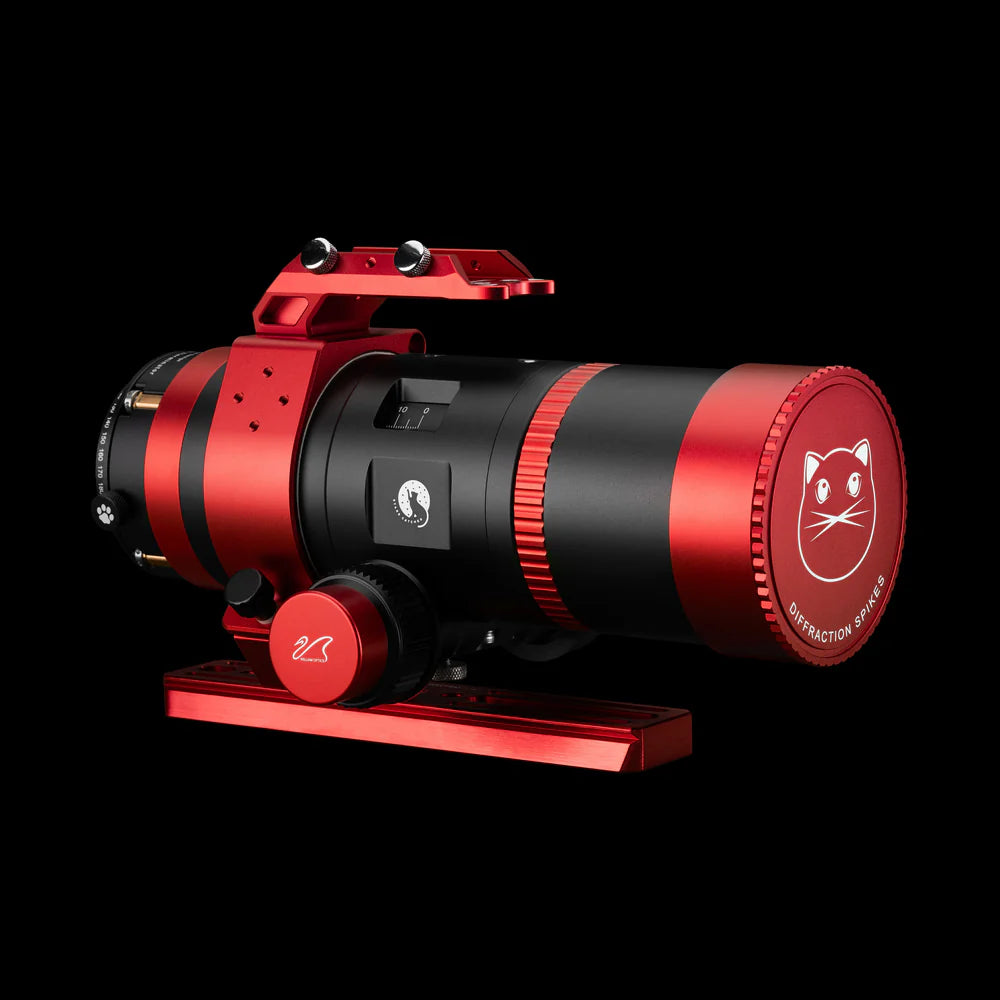
William Optics Ultra-Cat 56 and Ultra-Cat series more broadly
The ToupTek HOPE D60 is a planar apochromatic refractor designed for astrophotography and wide-field deep sky observation. Compact and lightweight, it combines portability with professional optics. Its five-lens design minimizes chromatic aberration and ensures sharp images across the entire field. This model is ideal for beginners looking for an easy-to-use instrument, as well as advanced users seeking a high-performance astrograph.
Virtually zero chromatic aberration thanks to the PAPO quintuplet lens
Native flat field, round and sharp stars across the entire sensor
Fast f/4.66 focal ratio for capturing more light in short exposures
Precise and stable focusing with coarse and fine control
Compact and lightweight, easy to carry
Compatible with most motorized focusing systems
Not suitable for traditional visual observation
Not suitable for planetary astrophotography
Field slightly limited by the size of the image circle (although full frame)
The SVBONY MK127 is a compact Maksutov-Cassegrain telescope offering high-performance optics in a portable format. It is designed for lunar, planetary, and nebular observation. Thanks to its three-mirror design and flat field, it effectively corrects coma and astigmatism, producing sharp, high-contrast images. Lightweight and easy to assemble, it combines portability and precision, ideal for demanding amateur astronomers.
High-precision Maksutov-Cassegrain optics for sharp, high-contrast images
Flat field correction and minimized aberrations
Built-in focal reducer for a wider field of view
Precise focusing thanks to the dual-speed system
Portable and relatively lightweight for a 127 mm diameter
Compatible with most standard accessories (2″ and 1.25″)
Narrow field of view at native focal length f/11.8
Cooling time required for optimal performance
Less versatile for deep sky viewing compared to fast refractors
Not optimized for wide-field astrophotography without a reducer

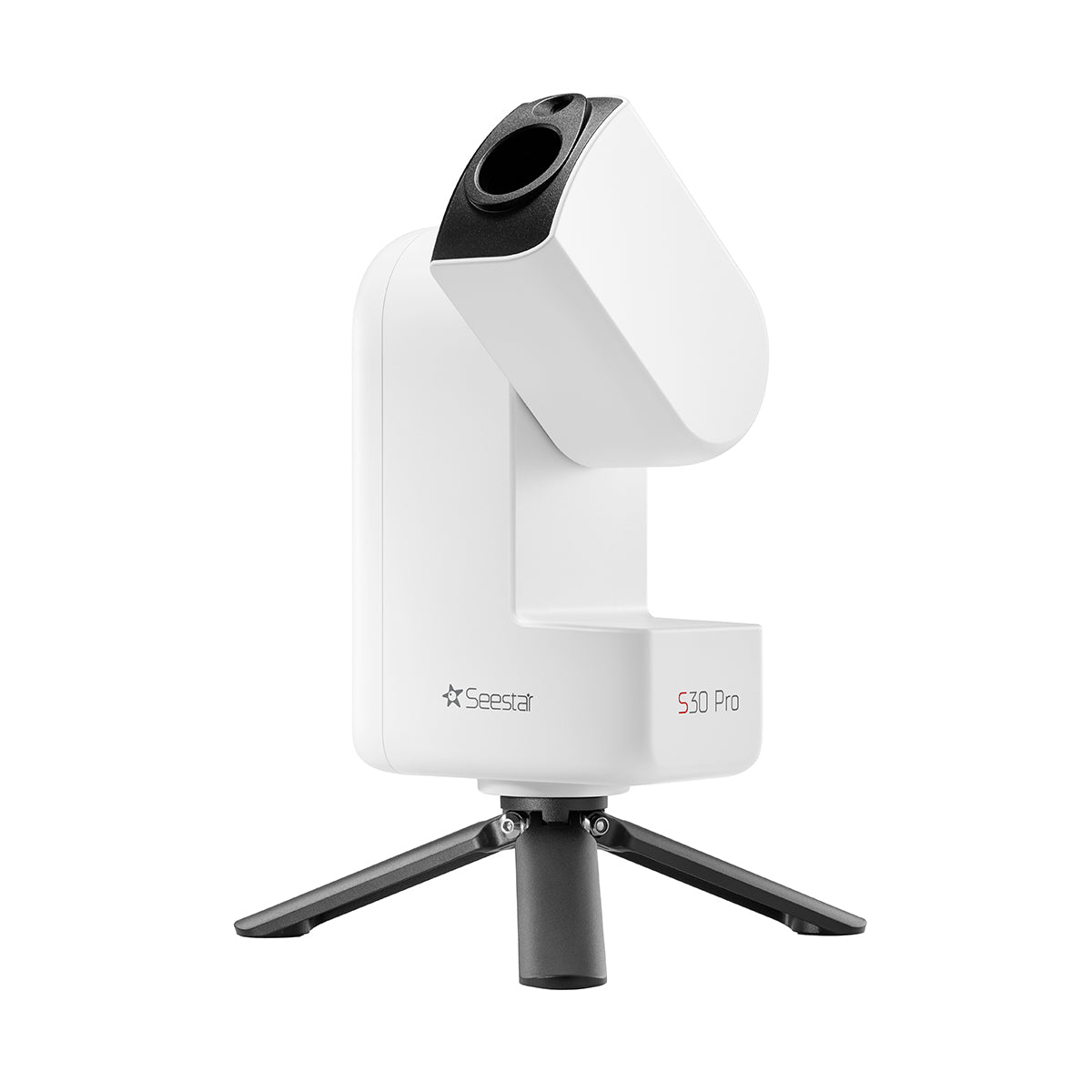
The ZWO Seestar S30 PRO is an all-in-one smart telescope designed for automated astrophotography and simplified celestial observation. Compact and lightweight (1.65 kg), it combines a telescope, camera, altazimuth mount, autofocus, and filters in a single package. Using the mobile app, it automatically locates, tracks, and captures more than 80,000 deep-sky objects, providing a seamless experience for beginners and enthusiasts alike.
All-in-one system: integrated telescope, camera, filters, and mount
Smart control via app and AI assistant to automatically guide, locate, and track stars
Dual 4K lens for wide angle and telephoto, sharp resolution, and reduced noise
Milky Way mosaic capture and automated 8K stitching
Smart separation of landscape and sky for sharp images
Compatible with ASCOM Alpaca protocol for third-party software
Daytime observation possible as an ultra-light telephoto lens
Not optimized for planetary targets
Total dependence on the app and connectivity for most functions
Less modular than a conventional telescope for adding optical accessories
Battery life limited to 6 hours, requiring recharging for long sessions
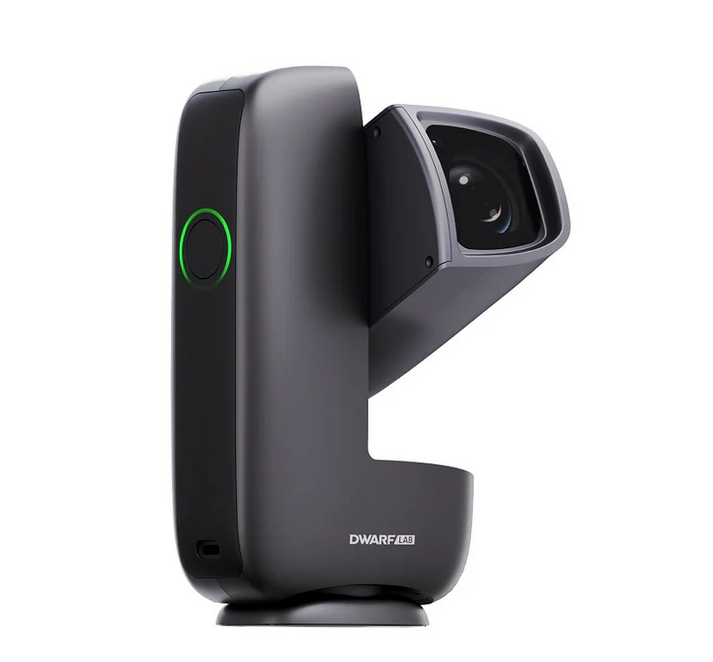
The DWARF Mini is the world's most portable smart telescope, combining light weight with professional performance. Weighing only 1.8 lbs, it allows you to explore the sky wherever you are, from your backyard to the top of a mountain. Automatic and quick to set up, it calibrates, points, and tracks celestial objects in minutes. Ideal for beginners and travelers, it accurately captures the Moon, planets, nebulae, and the Milky Way.
Ultra-lightweight and portable: ideal for travel and mobile observation
Automatic calibration and pointing in just a few minutes
Precise star tracking with exposures of up to 90 seconds in equatorial mode
Built-in triple filter to optimize contrast according to night conditions and light pollution
Control via app and onboard processing for immediate editing
Diverse capture: Milky Way, deep sky, planets, Sun, Moon, and astronomical mosaics
Limited sensor and aperture for detailed photography of very faint objects
Dependence on the mobile app for most functions
Only 4 hours of battery life for long sessions without recharging
Less flexible than a conventional telescope for adding optical accessories
The William Optics Ultra-Cat 56 is a high-end apochromatic Petzval telescope designed for wide-field astrophotography. Compact and lightweight, it combines portability with advanced optical performance. Its fast f/4.8 aperture and 50 mm image circle ensure sharp stars from edge to edge without the need for additional correctors. Optimized for full-frame, APS-C, Micro 4/3, and medium format sensors, it enables detailed images of nebulae and large-scale deep sky objects.
5-element Petzval lens with field curvature correction
Sharp, flat images across a 50 mm image circle
Fast f/4.8 aperture for capturing more light in less time
Stable WIFD focus compatible with EAF electronic autofocus
Built-in tilt sensor for precise alignment
No flattener required, simplified installation
Lightweight and robust construction, ergonomic design
Compatible with a wide range of cameras and accessories
Aperture limited to 56 mm, less suitable for small targets
Slightly high price for a modest diameter
Less versatile for conventional visual observation
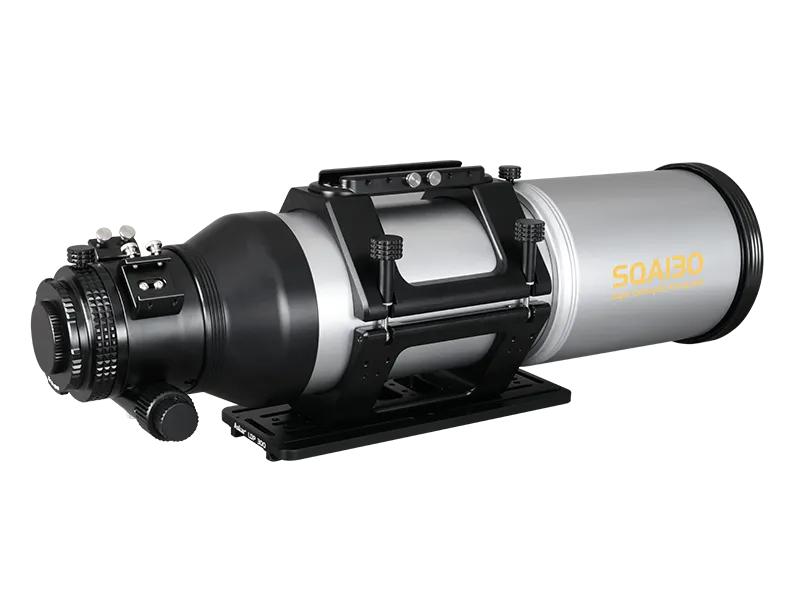
The Askar SQA130 is a high-end quintuple refractor astrograph designed for professional wide-field astrophotography. With a 130 mm aperture and f/4.8 focal ratio, it combines advanced Petzval optical design with two SD lenses for exceptional clarity and contrast. Its 44 mm full-frame image circle (expandable to 55 mm for medium format) ensures sharp stars from edge to edge, delivering high-precision images for demanding astronomers.
Quintuple optics with two SD lenses for optimal aberration correction
Excellent stellar performance: RMS < 2 µm at center, < 2.4 µm at 55 mm
Uniform illumination: >95% at 44 mm, >85% at 55 mm, vignetting control
Rigid dual-speed focuser compatible with motorization for precise pointing
360° rear rotator with graduation for exact adjustments
High-quality CNC machined, anodized, and durable construction
Compatible with professional, mirrorless, and DSLR cameras via adapters
Heavy weight (OTA 9.18 kg) and bulky size
Requires motorized mount for long exposure astrophotography
High price, targeting professional astrophotographers
The Spectrum Optics DS 8 and DS 10 Dobsonian DeepSky telescopes offer excellent value for money for observing deep sky objects, planets, and the Moon. With apertures of 200 mm (8″) and 254 mm (10″) respectively, these Dobsonians produce bright, sharp, and detailed images. Their robust and intuitive design allows for smooth tracking and precise focusing, ideal for amateur astronomers who want a high-performance, easy-to-use telescope.
Large apertures for deep sky and planetary viewing, offering high brightness and detail
Precise focusing with dual-speed Crayford focuser
Smooth tracking thanks to Teflon bearings and adjustable tension settings
Robust mechanical design that is easy to assemble
Unique spider vane design that reduces diffraction spike effects
Excellent value for money for telescopes in this category
Fixed Dobsonian mount: no built-in motorized tracking
Heavier and larger size for the DS 10, less suitable for frequent travel
Limited for long exposure astrophotography without motorization or external guiding
Not directly compatible with motorized equatorial mounts
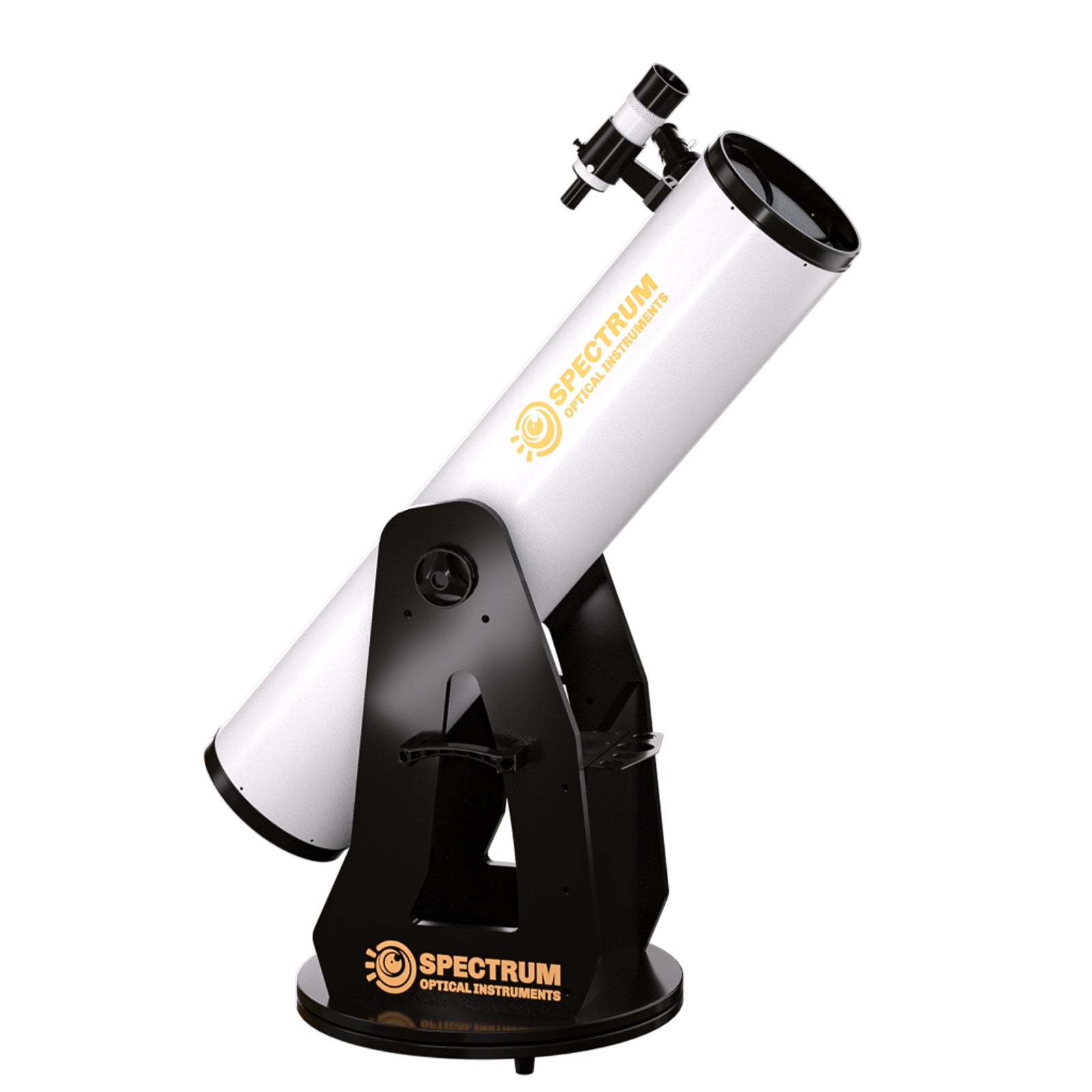
Spectrum Optics DeepSky Dobsonian 8″
Spectrum Optics DeepSky Dobsonian 10″
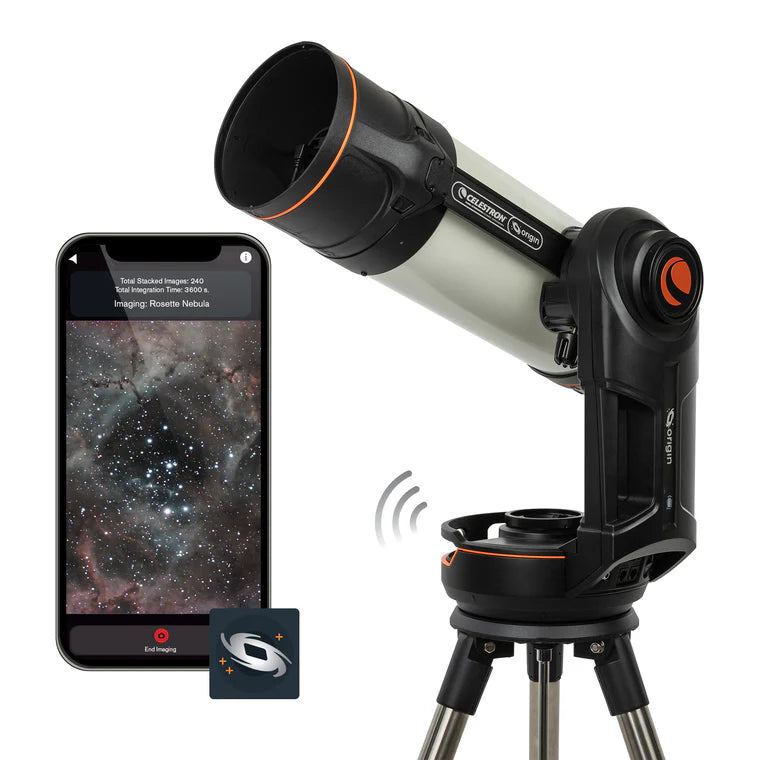
The Celestron Origin Mark II is an all-in-one home observatory combining a RASA 6 f/2.2 telescope and Origin 678C camera. It quickly captures sharp images of celestial objects on your phone or tablet thanks to automatic AI processing. StarSense alignment and an intuitive interface allow you to image galaxies, nebulae, and star clusters in less than two minutes, while also offering terrestrial viewing and live sharing.
Very bright and ultra-fast telescope, ideal for deep sky viewing with very short exposure times
All-in-one system with automatic real-time image processing using AI
Automated alignment and pointing via StarSense: ready to use in less than two minutes
Live sharing and compatible with multiple users and Smart TVs
High-resolution sensor with fine pixels for precise details
Observation possible day and night, for deep sky and terrestrial use
Intuitive interface via the Celestron Origin Powered by SkySafari™ app
High price compared to traditional telescopes
Relatively heavy and bulky system for a smart telescope
Dependence on the mobile app to take full advantage of all features
Built-in camera: less flexible for some advanced uses requiring cooled sensors
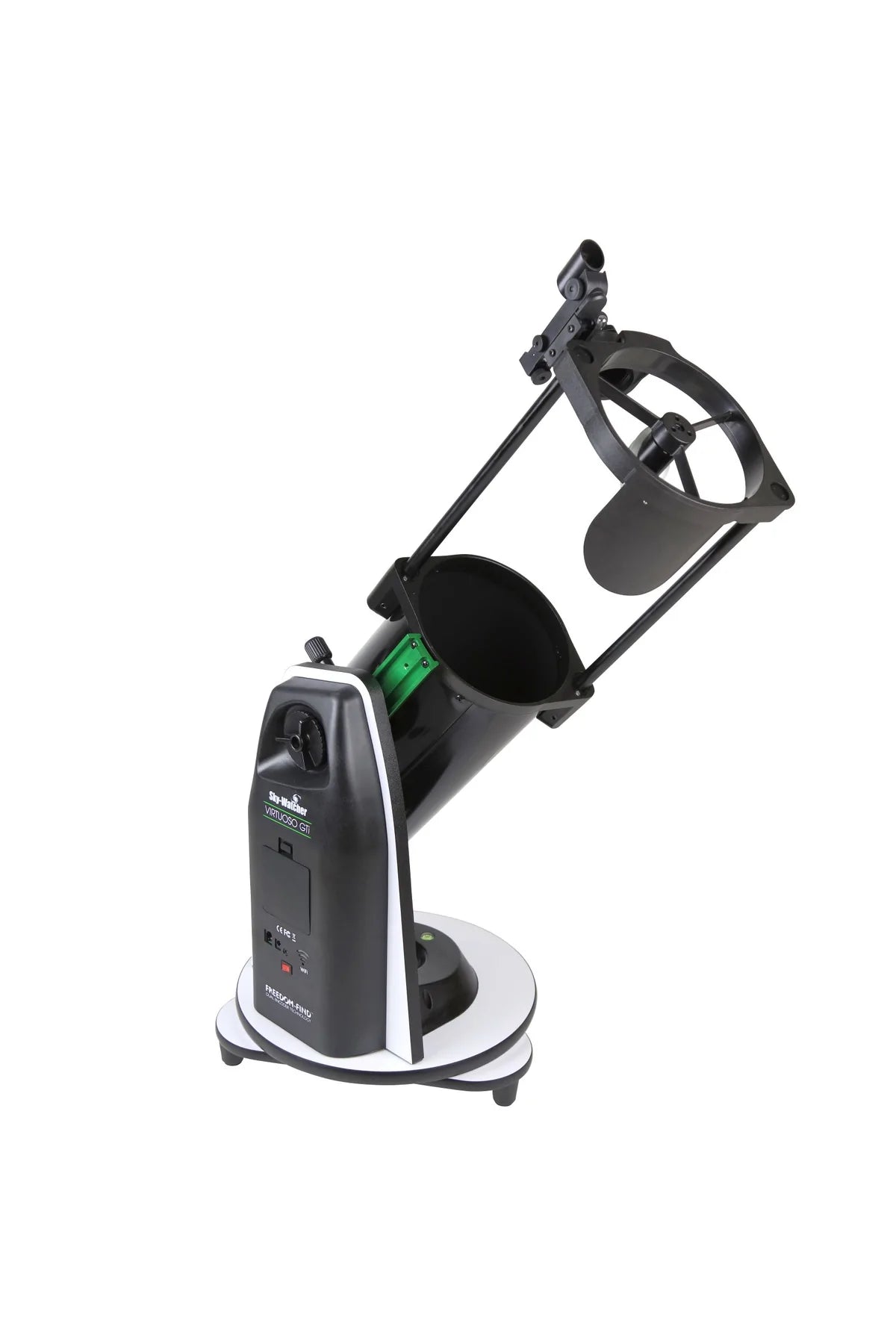
The Sky-Watcher Virtuoso DOB150 GTi is a foldable tabletop Dobsonian telescope that combines portability with optical power. With a 6-inch aperture and Wi-Fi connectivity, it can be controlled via smartphone using the SynScan Pro app. Versatile, it offers superb views of the Moon, planets, and galaxies. Freedom Find™ technology maintains alignment in manual control, and the app provides access to over 10,000 celestial objects for accurate tracking. The perfect telescope for beginners.
Very compact and foldable: easy to transport and store
Built-in Wi-Fi and GoTo control via smartphone for intuitive use
Precise tracking and quick alignment thanks to Freedom Find™ and SynScan Pro
150 mm aperture for bright, detailed images
Compatible with DSLR photography thanks to dedicated interface
Versatile: suitable for the Moon, planets, deep sky, and terrestrial observation
Requires a stable surface to place the telescope or the purchase of a tripod
Requires batteries or an external power supply for motorized operation
GoTo tracking dependent on the application and Wi-Fi connectivity
For long or precise astrophotography exposures, additional guiding may be necessary
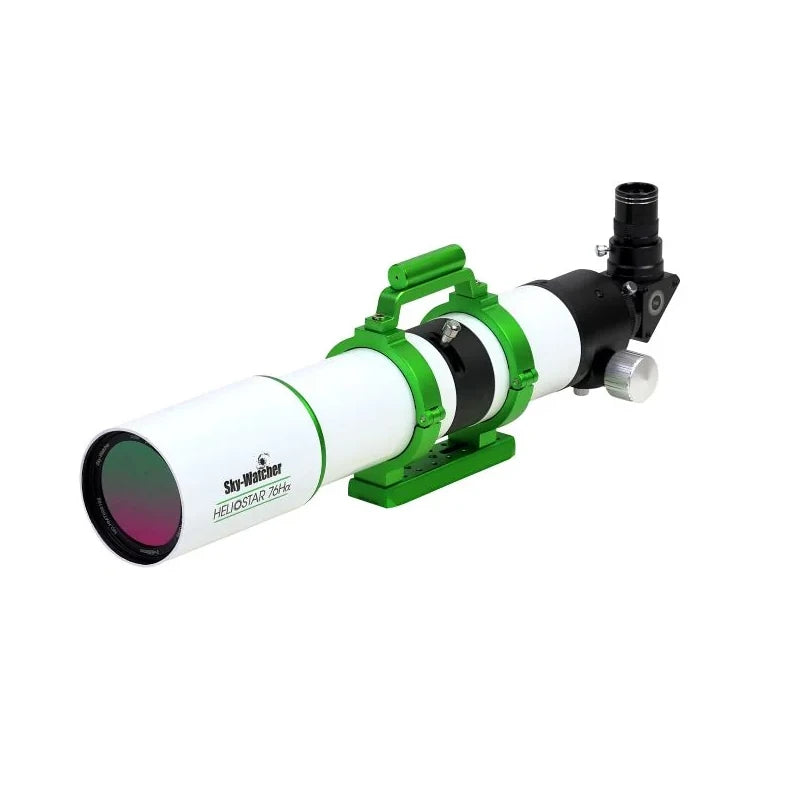
The Sky-Watcher Heliostar 76 mm H-Alpha is a dedicated solar telescope, offering detailed observation of prominences, filaments, sunspots, and granulation in the Hα wavelength. Its advanced etalon with Solis technology provides an ultra-fine bandwidth of <0.55 Å, ensuring exceptional performance and optimal safety certified by the Charlie Bates Project.
Designed specifically for Hα solar observation with incredible surface detail
Ultra-fine bandwidth <0.55 Å for high contrast without a double standard
Solis Etalon technology and Trifid tuner for precise and secure adjustment
Integrated solar finder for safe and fast pointing
Lightweight and easily transportable for solar observation on site or while traveling
Includes everything needed to observe and image the Sun right out of the box
Exclusively dedicated to solar observation: cannot be used for the Moon, planets, or deep sky
Requires extreme caution during use to avoid serious eye injury
Magnification limited to 150x, suitable only for solar observation
Manual system for certain filter adjustments, which may require learning to obtain optimal images
|
# |
Telescope |
Type / Use |
Aperture |
Focal Length |
Focal ratio |
Weight |
Strenghts |
|
1 |
Portable apochromatic refractor / Astrophotography |
60 mm |
280 mm |
f/4,66 |
3,5 kg |
PAPO quintuplet astrograph with integrated corrector, full-frame image circle ~44 mm, illumination >90%, 3" focuser, compact and lightweight |
|
|
2 |
Compact Maksutov-Cassegrain / Visual & astrophotography |
127 mm |
1500 mm |
f/11,8 |
2,93 kg |
High-contrast closed optics, flat field correction, compact and portable, ideal for the Moon, planets, and bright deep sky objects, 1.25″ and 2″ interfaces, dual-speed internal focuser |
|
|
3 |
All-in-one smart telescope / Wide-field astrophotography |
30 mm telephoto lens / 3.4 mm wide-angle lens |
160 mm telephoto lens / 6 mm wide angle |
f/5,3 / f/1,75 |
1,65 kg |
Sony IMX585 & IMX586 sensors, ultra-portable, automatic processing and stacking, built-in triple filter, Wi-Fi/Bluetooth, ideal for deep sky and Milky Way photography |
|
|
4 |
Portable smart telescope / Astrophotography |
30 mm |
150 mm |
na |
840 g |
Ultra-portable, automatic, long exposures up to 90 s, built-in triple filter, one-click processing |
|
|
5 |
Wide-field apochromatic telescope |
56 mm |
269 mm |
f/4,8 |
3,21 kg |
5-element Petzval optics, 50 mm image circle, internal WIFD, no flattener required |
|
|
6 |
Deep sky quintuplet refractor |
130 mm |
624 mm |
f/4,8 |
11,76 kg |
Large aperture, medium format compatible, quintuplet optics with SD, high MTF, dual-speed focuser |
|
|
7 |
Dobson deep sky |
200 mm |
1200 mm |
f/5,9 |
13 kg |
Crayford 2-speed eyepiece holder, tilting housing with Teflon pads, bright images, curved spider |
|
|
7 |
Dobson deep sky |
254 mm |
1200 mm |
f/4,7 |
17 kg |
Crayford 2-speed eyepiece holder, large 10" aperture, bright and detailed images, smooth azimuth mount |
|
|
8 |
Home observatory / Astrophotography |
152 mm |
335 mm |
f/2,2 |
18,87 kg |
RASA f/2.2, built-in 8.4 MP camera, AI for automatic stacking, positioning, and alignment |
|
|
9 |
Foldable table Dobson / GoTo |
150 mm |
750 mm |
f/5 |
19,86 kg |
Foldable tube, Wi-Fi GoTo, Freedom Find, database of over 42,900 objects, RAQ 94% optics |
|
|
10 |
Hα solar telescope |
76 mm |
630 mm |
f/8,3 |
3,8 kg |
Hα solar observation, bandwidth <0.55 Å, Solis standard, integrated finder, ready to use |
There is no single best telescope, but rather an instrument suited to each astronomical project. The choice of a telescope depends on its actual use: observing stars, exploring galaxies, practicing astrophotography, or simply discovering the sky.
At Astronomy Plus, we help amateur astronomers choose the right telescope for their sky, budget, and curiosity.
{"one"=>"Select 2 or 3 items to compare", "other"=>"{{ count }} of 3 items selected"}
Leave a comment