We Have it in Stock? We're on it, shipping your order on the same day.
*Ordered before 2PM ET & Business Hours only / This is an estimation and may vary
What if the product is not in stock?
🛫 If the item is unavailable: It may be in transit to us or on order with the supplier. If not, we will promptly place the order. In case of delays, we will do our best to keep you informed. Don't hesitate to email us for delays.
🇨🇦 Canadian Authorized Dealer
Buy with confidence from a trusted Canadian astronomy retailer. We provide full pre-sale and after-sale support, expert advice, warranty assistance, and real technical help from passionate astronomers.
Share:
Player One Uranus-C USB3.0 Color Camera IMX585 (Uranus-C)
Camera:Camera
ASTRONOMY PLUS
Pickup available,
Usually ready in 2 hours
3008 Rue Brodeur O Unité 307 Saint Alphonse De Granby QC J0E 2A0 Canada
4504635072
Player One Uranus-C USB3.0 Color Camera IMX585 (Uranus-C)
Player One Uranus-C USB3.0 Color Camera IMX585 (Uranus-C) - Camera
is backordered and will ship as soon as it is back in stock.
Player One Uranus-C USB3.0 Color Camera IMX585
Designed for planetary imaging and EAA & Lucky imaging!
Uranus-C and Mars-C II is not only for planetary imaging, but also very powerful for EAA & Lucky imaging!
Uranus-C is (IMX585) camera developed by Player One Astronomy, which adopts the newest Sony IMX5851/1.2” format color sensor. The 2.9um pixel size accommodates a well depth of 38.8Ke with a total of 8.3MP (the resolution is 3856*2180), and the diagonal is 12.85mm.
STARVIS 2 Technology
Uranus-C (IMX585) and Mars-C II (IMX662) based on Sony newest STARVIS 2 technology, it is back-illuminated pixel technology used in CMOS image sensors.
Format
Uranus-C (IMX585) has 1/1.2″ format, this size is quite big for imaging.
Full well
Uranus-C (IMX585) has 38.8Ke full well, it’s almost 3 times than IMX485 (13Ke).
Highlights
Non-Amp-Glow
Biggest supprise of Uranus-C (IMX585) camera is, its dark frame is totally “dark”, whatever we strength the curve, there is no AMP glow at all!
300s dark frame of Uranus-C camera(resize to 50%):
Non-Amp-Glow can give us very clean background, much easier to get high quaility images.
Recommended accessories:
ACS (Active Cooling System) is a external air-cooled system, designed for solar and big format planetary cameras which already has PCS (Passive Cooling System).
ACS can provide much better temperature control. When camera has PCS + ACS, temperature is only 7℃ higher than ambient, camera body is a little warm but won’t hot!
ACS is not only can be used in daylight for solar imaging, it also could be used in night for DSO lucky imaging.
2nd Gen – Sensor Tilt Plate
When taking deep sky objects, using sensor tilt plate can get a much smaller field curvature of the telescope.
The built-in high-density sponge shading pad can block the light from the side slits without any side leakage.
Passive Cooling System
Player One add a new feature called Passive Cooling System to conduct the heat from the sensor out.
256M DDR3 Cache
Player One Astronomy cameras are the first one who adopts the DDR3 cache in all planetary cameras in the world! It helps stabilize and secure data transmission, it effectively avoids frame dropping and greatly reduces readout noise.
With the DDR3 cache, the camera does not have high demands on computing needs any longer, it will still has excellent performance even if it is connected to a USB 2.0 port.
DPS technology
The planetary cameras from Player One Astronomy have DPS (Dead Pixel Suppression) technology. The DPS is anaylse many dark frames to find out thoes fixed abnormal pixel and record the map in camera memory. In imaging, each exposure frames, thoes position of dead pixels will be given a median value according to the active pixels around that abnormal pixel.
Overvoltage and overcurrent protection mechanism
Player One cameras produced by us ensures the safety of your camera and other equipment through overvoltage and overcurrent protection mechanisms.
Data Port
When the camera is connected to the USB3.0 interface and full-resolution preview is used, it can reach 47 FPS in RAW8 mode (10bit ADC). When recording images, since the actual writing speed will be affected by the writing speed of the hard disk itself, when the hard disk writing speed is slow, the recording may not reach the theoretical speed. It is recommended that you use a high-quality solid state drive to record data to give full play to the performance of the camera.
Use the ST4 guide cable to connect the camera and the AUTO GUIDE port of the equatorial mount to do guiding.
Technical Specifications
Sensor
New SONY IMX585 1/1.2" CMOS (color)
Diagonal
12.85mm
Total Pixels
8.3 Mega Pixels
Max Resolution
3856×2180
Pixel Size
2.9μm
Chip Size
11.2mm×6.3mm
Frame Rate
47FPS(10bit)
Bayer Matrix
RGGB
Shutter
Rolling shutter
Exposure Range
32μs-2000s
Readout Noise
6.5-0.7e
QE Peak
≈91%
Full Well
38.8k e
ADC
12 bit
Data Port
USB3.0/USB2.0
Adapter
1.25″ / M42X0.75
Back Focal Length
12.5mm
Protective Window
D32*2MM High Quality AR Plus (Anti Reflection) Multi-Layer Coating
Diameter
66mm
Weight
160g
Resolution and FPS
Under USB3.0 mode Resolution 10bit ADC 3856×2180 46FPS 3840×2160 47FPS 1920×1080 187FPS More resolution options could be setup in capture software
Aside from an eyepiece camera in my solar telescope, this is my first dedicated astronomy camera after many years of using a DSLR. I've only had two partially clear nights and they were cold and windy so I've only done a couple of short video captures of Jupiter. I still have lots to learn about using the camera (and SharpCap), but so far I'm enjoying it a lot. I'm using it on a small refractor (ED80) with a 2x Barlow so images are small but already a step up from what I could do with the DSLR. Looking forward to learning a lot more.
You will receive an email when your post is approved
Please leave this popup open whilst your media is uploading
From our customers
Comments
Be the first to comment!
Shop This Post
Price:
Original price:
Your cart
Player One
Player One Uranus-C USB3.0 Color Camera IMX585 (Uranus-C)
Regular priceFrom$51700
Unit price
Player One Uranus-C USB3.0 Color Camera IMX585
Designed for planetary imaging and EAA & Lucky imaging!
Uranus-C and Mars-C II is not only for planetary imaging, but also very powerful for EAA & Lucky imaging!
Uranus-C is (IMX585) camera developed by Player One Astronomy, which adopts the newest Sony IMX5851/1.2” format color sensor. The 2.9um pixel size accommodates a well depth of 38.8Ke with a total of 8.3MP (the resolution is 3856*2180), and the diagonal is 12.85mm.
STARVIS 2 Technology
Uranus-C (IMX585) and Mars-C II (IMX662) based on Sony newest STARVIS 2 technology, it is back-illuminated pixel technology used in CMOS image sensors.
Format
Uranus-C (IMX585) has 1/1.2″ format, this size is quite big for imaging.
Full well
Uranus-C (IMX585) has 38.8Ke full well, it’s almost 3 times than IMX485 (13Ke).
Highlights
Non-Amp-Glow
Biggest supprise of Uranus-C (IMX585) camera is, its dark frame is totally “dark”, whatever we strength the curve, there is no AMP glow at all!
300s dark frame of Uranus-C camera(resize to 50%):
Non-Amp-Glow can give us very clean background, much easier to get high quaility images.
Recommended accessories:
ACS (Active Cooling System) is a external air-cooled system, designed for solar and big format planetary cameras which already has PCS (Passive Cooling System).
ACS can provide much better temperature control. When camera has PCS + ACS, temperature is only 7℃ higher than ambient, camera body is a little warm but won’t hot!
ACS is not only can be used in daylight for solar imaging, it also could be used in night for DSO lucky imaging.
2nd Gen – Sensor Tilt Plate
When taking deep sky objects, using sensor tilt plate can get a much smaller field curvature of the telescope.
The built-in high-density sponge shading pad can block the light from the side slits without any side leakage.
Passive Cooling System
Player One add a new feature called Passive Cooling System to conduct the heat from the sensor out.
256M DDR3 Cache
Player One Astronomy cameras are the first one who adopts the DDR3 cache in all planetary cameras in the world! It helps stabilize and secure data transmission, it effectively avoids frame dropping and greatly reduces readout noise.
With the DDR3 cache, the camera does not have high demands on computing needs any longer, it will still has excellent performance even if it is connected to a USB 2.0 port.
DPS technology
The planetary cameras from Player One Astronomy have DPS (Dead Pixel Suppression) technology. The DPS is anaylse many dark frames to find out thoes fixed abnormal pixel and record the map in camera memory. In imaging, each exposure frames, thoes position of dead pixels will be given a median value according to the active pixels around that abnormal pixel.
Overvoltage and overcurrent protection mechanism
Player One cameras produced by us ensures the safety of your camera and other equipment through overvoltage and overcurrent protection mechanisms.
Data Port
When the camera is connected to the USB3.0 interface and full-resolution preview is used, it can reach 47 FPS in RAW8 mode (10bit ADC). When recording images, since the actual writing speed will be affected by the writing speed of the hard disk itself, when the hard disk writing speed is slow, the recording may not reach the theoretical speed. It is recommended that you use a high-quality solid state drive to record data to give full play to the performance of the camera.
Use the ST4 guide cable to connect the camera and the AUTO GUIDE port of the equatorial mount to do guiding.
Technical Specifications
Sensor
New SONY IMX585 1/1.2" CMOS (color)
Diagonal
12.85mm
Total Pixels
8.3 Mega Pixels
Max Resolution
3856×2180
Pixel Size
2.9μm
Chip Size
11.2mm×6.3mm
Frame Rate
47FPS(10bit)
Bayer Matrix
RGGB
Shutter
Rolling shutter
Exposure Range
32μs-2000s
Readout Noise
6.5-0.7e
QE Peak
≈91%
Full Well
38.8k e
ADC
12 bit
Data Port
USB3.0/USB2.0
Adapter
1.25″ / M42X0.75
Back Focal Length
12.5mm
Protective Window
D32*2MM High Quality AR Plus (Anti Reflection) Multi-Layer Coating
Diameter
66mm
Weight
160g
Resolution and FPS
Under USB3.0 mode Resolution 10bit ADC 3856×2180 46FPS 3840×2160 47FPS 1920×1080 187FPS More resolution options could be setup in capture software
ZWO ASI585MC USB3.0 Color Astronomy Camera - OPEN BOX (ASI585MC)
David W Vandenberg
Excellent Service
Products as described, arrived 3 days before due date.
This is a great deep sky scope, and I am looking forward to getting some great pictures with it, all I need now are some clear skies (it's raining at the moment)
Astronomy Plus Pier Extension for ZWO, iOptron and Sky-Watcher Mounts
Claude Lamarre
ASTRONOMIK MC CLEAR FILTER 2’’ SCT 24 TPI
Se visse directement sur l’adaptateur 2’’ SCT 24 TPI
ASTRONOMIK MC CLEAR FILTER 2’’ SCT 24 TPI
Se visse directement sur l’adaptateur 2’’ SCT 24 TPI , votre dos visuel se visse sur le ASTRONOMIK MC CLEAR FILTER 2’’ SCT 24 TPI.
1) Permet de sceller le tube optique. Une touche de graisse de silicone pure, de qualité, celle pour les équipements de plongée assure l’étanchéité.
2) Empêche les contaminants de s’infiltrer
3) Empêche l’effet cheminée lorsqu’on change un oculaire ou un accessoire par temps froids.
4) Combiné à une isolation thermique de l'OTA un isolant thermique à double face genre REFLECTIX, permet de sortir l’instrument d’un local chauffé vers la température frigide extérieure pour observer immédiatement sans attendre l’équilibrage des températures.
J’ai testé de 25C à 5C, sur deux nuits à l’oculaire clavé 10mm dès l’installation 5 minutes après la sortie de l’instrument, l’image est absolument nette avec seulement la turbulence d’un seeing de 3-4, et ce durant toute la durée de la séance.
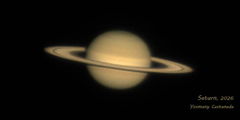
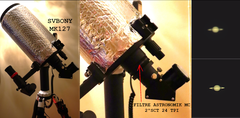
Images de Saturne au MK127 de SVBONY F:1500mm, Caméra ZWO ASI 678MC au foyer primaire, Filtre 1.25" Baader contrast boost, capture .SER, Sharpcap, PIPP, AS4!, registax 6.
Les photos sont un stack des images brutes stabilisé de PIPP, et l'autre un léger traitement dans Registax 6.
Le 27 octobre vers 21h30 5 à 10 minutes après avoir sorti l’instrument, viewing 3/5. Hier avec barlow QT 2,25x Baader, résultat similaire. C'est ce que j'espérait, les tests se poursuivre.
Astronomik MC-clear Filter
Darus
Helpful staff and competitive pricing make them a solid choice
Astronomy Plus is a reliable Canadian retailer specializing in telescopes and astrophotography gear.
Their product selection is excellent — everything from smart telescopes like the Seestar series to mounts, cameras, filters, and accessories from top brands. Items arrive in perfect condition and are well-stocked.
Shipping is impressively fast!
Astronomy Plus – Telescopes & Astrophotography Canada
Nice product, I hope it works for me. I put the tri-baht together properly, it snaps together easily. Problem, it does not fit my 11” Celestron cat. The hole in the center is too small by a millimetre so the tri-baht will not attach securely. Any suggestions?
Hi Mike, thanks for the detailed feedback, and sorry the mask isn’t securing properly on your 11” Celestron. Please contact us with your exact telescope model. What is your C11 version. Classic, Edge HD? This is probably why it does not work.